Monday, September 1, 2008

A new addiction


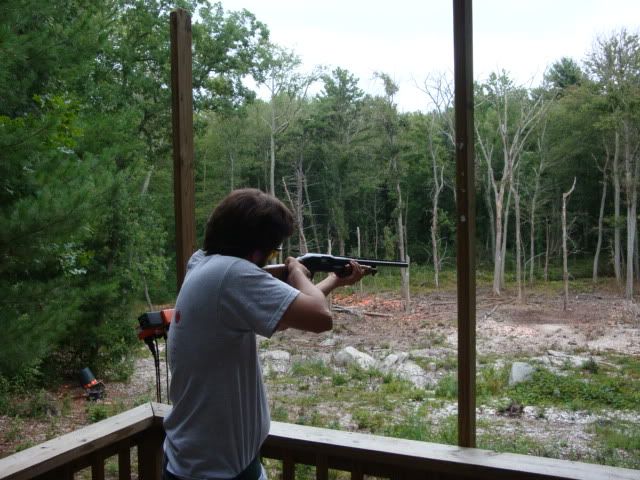
On Saturday, I went to Addieville East Farm in Rhode Island for a friend's bachelor party. My previous shotgunning experience probably totaled about one box of shells including about 10 clays off a manual thrower at the Bloggershoot. So, I had no idea what I was in for in a round of sporting clays.

For those who don't know, sporting clays is basically golf with a shotgun. You walk through the woods to a sequence of stations. At each station, there are two clay throwing machines. The throwers are sat at varying locations relative to the shooting position. Some are on the ground, some are up in the air. Some throw toward you, some away, and some across. Most of the stations on the portion of the course I did (I had to leave after lunch to get to a wedding.) were 'report pairs'. What this means is that you call for the first target, and the second one is launched when you fire at the first one.

I mostly used a borrowed Mossberg 500. That was nice, as that's the shotgun I'm thinking of buying. I did try an O/U for the one station that was a true pair (both targets launched simultaneously). It pretty much cemented my plan to buy a 500. It's cheaper than the 870, and I like the position of the safety and slide release better.

I had a great time and broke what I think was a decent number of clays for my first time out. In fact, I had so much fun that yesterday I swung by Wal-Mart and grabbed some shotshells. I then went to my club, which has trapshooting on Sunday afternoons. I watched the tail end of a round and then talked to one of the shooters. When I told him that I was thinking of buying a shotgun and was curious about shooting trap and had brought a couple boxes of shells, he was happy to offer up his shotgun for me to try.

This one was a fancy O/U. I didn't catch the brand, but it doesn't really matter because I'm sure it's out of my price range. I did like the O/U for convenience of loading for clay games. I may buy one eventually, but I'm still planning to start with a pump because of cost and versatility. O/Us are great for target shooting, but when a home invader is coming down the hallway, I want more than two rounds.

I shot a 15 the first round, which I didn't think was too bad for my first round of trap ever. The shooters decided to shoot one more round, and the guy whose shotgun I was borrowing was done shooting for the day, so I decided to try again. This time I focused on his advice to swing smoothly through the shot and follow through. I broke 21 of 25 targets in the 2nd round, which I think is pretty good for a beginner. Targets at sharp angles from stations 1 and 5 give me fits, but I'm sure that just takes more practice.

I was hoping to hold out from buying any more guns for a while, but I had so much fun shooting clays this weekend that I think I'm going to have to get a shotgun. I'm planning to get a Mossberg 500. I'm deciding between a cheap used one and the "Field/Security Combo" if I go new. I'm leaning toward the new combo as it doesn't cost much more than a used gun plus an extra barrel.

Sunday, August 31, 2008

Quote of the Day

"Whenever Senator Obama attempts anything non-political (such as bowling), he comes over like a visiting dignitary to a foreign country getting shanghaied into some impenetrable local folk ritual."

Mark Stein on National Review Online. H/T to Ted at BorePatch

Friday, August 29, 2008

Quote of the Day

"In the same way that the Democrats made the "McSame" argument all week, the convention in St. Paul next week will most likely attempt to paint Obama as the typical big government, tax-and-spend Democrat. What is the price tag in the hope Obama is selling?"
-- Josh Putnam Frontloading HQ

In my opinion, both of the accusations are true. I think his question would make a great McCain ad. I'm eagerly awaiting McCain's VP pick. I'm hoping for Sarah Palin, but I'm expecting to be disappointed.

Saturday, August 2, 2008

Back in the saddle

I have a tendency to acquire hobbies. I find something that interests me and tend to jump in with both feet. Shooting is the latest in a long string. Between working on my house, which ate most of last summer and fall, and shooting, which has eaten most of this spring and summer, I've been leaving other hobbies languish. Lately I've resolved to pick two hobbies and stick with them. Shooting is one, homebrewing, which has fallen by the wayside for a while is the other. Last weekend I brewed my first batch in about a year.

Last weekends batch was an English IPA. It was an extract batch, which means I started from malt extract, which is basically pre-made dehydrated wort. Wort is the term for unfermented beer. Basically, with extract, the first third of the brewing process is done for you. Extract is easier and requires less equipment, but extract costs more than malted grain.

The stages of making beer are malting, mashing, boil, and fermentation. Malting is the processing of barley by allowing it to germinate to produce enzymes, and then kilning it to stop the process. Different strains of barley and different roasting and kilning processes lead to different types of malt. Almost no one does this at home, and professional breweries don't do it either. It's generally done by malt houses which purchase grain from the farmers, malt it, and sell it to distributors and brewers.

The next step is mashing. Mashing is the process of using the enzymes from malting to convert the starches in the grain into sugars which the yeast can ferment. This is done by mixing the malt with hot water and holding it at a temperature or series of temperatures to control the enzyme activity.

The next step is the boil. This is where the process starts for extract brewers. Boiling does several things for the brew. The most important is that it extracts bitterness from the hops. Even beers that aren't noticably bitter contain bittering hops. If they didn't they'd taste cloyingly sweet. This is because yeast can't ferment 100% of the sugars in the beer, so the hop bitterness is there to balance them out. The boil also drives off some compounds that you don't want in the beer because they produce off-flavors. Another thing the boil does is coagulate some proteins from the malt that would otherwise make the final beer cloudy.

The final step (other than packaging) is fermentation. This is where the magic happens. Yeast convert sugars to alcohol and CO2. There is a wide variety of brewers yeasts available that lead to a variety of different flavors in the final beer. Temperature control during fermentation is important to avoid off flavors and other unpleasant things you don't want in the beer. Also, a given yeast will produce a different flavor profile at different temperatures.

After fermentation, the beer is packaged in either bottles or kegs and then carbonated. There are two main ways to carbonate a beer: bottle conditioning and force carbonation. Bottle conditioning involves adding a measured amount of sugar to the beer so that it will ferment a bit more in the bottle. Since the bottle is sealed, the CO2 produced dissolves into the beer. The other method is force carbonation, which is using a pressurized CO2 tank to add CO2 to the beer.

So, back to today's batch. Today I made an all grain beer. This is significantly more involved than an extract batch. The short version is that last week's extract beer took about 3 hours start to finish. Today's brew is going to come to about 6. I had some equipment issues today that pushed the time out. Once I get back into the swing of things, I think I can get an all grain brew day down to about 4.5 hours or so.

I'll post details of ingredients and such later, this post has gone on long enough. The next beer post will probably also include my planning for the next couple batches.

Friday, July 25, 2008

I love the CMP part the second


The rifles arrived not long after my last post. The Carbine is pretty clean, but the Garand is pretty gunked up with cosmolene. Condition seems to be good at first glance; bright shiny bores with sharp rifling. The wood is pretty good; scratches and dings, but I didn't see any cracks or anything. I'll look them over further when I have more time. I was pleased to note that my IBM Carbine has a matching IBM barrel. The adjustable sights cover the maker's name on the receiver, so the barrel stamped IBM Corp will make it easier to show off to non-gunnie friends.

I love the CMP, part the first


The software just arrived on the FedEx ground truck. The hardware should be arriving shortly on the express truck. The driver came to my door, confirmed my address and asked if I could open the garage because he had a 'bunch of heavy boxes'. (My garage is at ground level, while my front door is up a hill.) Said heavy boxes included 3 cans of 192 rounds of .30-'06 in Garand clips and bandoleers, 2 cans of 400 .30-'06 in boxes of 20, and 1 box of 500 rounds of .30 Carbine. Assuming the hardware arrives as scheduled, I should be set for the first wave of zombies.

Thursday, July 24, 2008

Priority Overnight My Ass

No CMP rifle pics today, thanks to the wonders of FedEx. They were shipped priority overnight yesterday, picked up by FedEx at 1:42 PM. I worked from home this morning to be there to sign for the package. FedEx's tracking site showed that they were to be delivered by 10:30 AM. They arrived at Boston at 9:23 AM. I figured at this point that they weren't going to make 10:30, since I'm about a 45 minute drive from Boston(with no traffic). Then at 11:12, they arrived at another fedex facility which is half an hour from Boston, and 45 minutes from me. The tracking now says Delivery Exception: "Package at station, arrived after courier dispatch" At this point, I headed into the office since I had a 1PM meeting, and there was no way they'd make it in time.

I'm not sure if they'll attempt delivery some time this afternoon, or if it'll get bumped to tomorrow. How often does FedEx totally miss promised service like this? I use them at work to overnight stuff semi-regularly. I do product development, so generally it's not absolutely critical that the package arrives overnight. I remember one case where the package got delayed to the following day. It seems pretty rare that they hit the promised 10:30 AM delivery time.

Has FedEx service always been this marginal, or is it a more recent thing? Obviously, waiting an extra day for my rifles isn't the end of the world, but it does hurt my confidence in FedEx. What do businesses do when something is critical to operations and has to arrive the next day? Put the low man on the totem pole in a car and make him drive all night?